








A storybook for children aged 8–14

Stories that make children money smart.

Nine short, illustrated stories that gently teach saving, budgeting, needs and wants, inflation and the magic of compounding — the lessons most of us learned far too late.

4.4 on Amazon|170+ ratings

Now in its 4th print1st edition sold outDownload a free sample

Cover of Money Masters: Stories to Make Kids Money Smart

About the book

Money lessons, told the way children listen.

The way children learn is very different. What the present generation learned in their 30s or 40s would be a good idea for the next generation to start learning early. Bothering young kids with money pressure at an early age? No, this is just to playfully get them to learn the basic money concepts.

Here are 9 interesting stories to teach children about saving, emergencies, inflation, needs vs wants, delayed gratification, pay yourself first, budgeting, banking, the magic of compounding, financial freedom and diversification.

Each story has a different set of characters. The money lessons are skilfully woven in, so they come across naturally. The concepts and ideas were picked from years of teaching kids about money, running financial wellness sessions, and actually managing personal finances for many families.

Available on Amazon and T-Books. A Marathi edition is available on request.

Inside the book

Nine stories, nine lifelong lessons.

  1. Illustration from “Dev Learns to Save”
    01

    Dev Learns to Save

    Saving & emergencies

  2. Illustration from “Changing Times”
    02

    Changing Times

    Inflation

  3. Illustration from “Akash Goes Shopping”
    03

    Akash Goes Shopping

    Needs vs wants

  4. Illustration from “Neha's Trip to Japan”
    04

    Neha's Trip to Japan

    Pay yourself first

  5. Illustration from “Month End”
    05

    Month End

    Budgeting

  6. Illustration from “Palak's Piggy Bank”
    06

    Palak's Piggy Bank

    Banking

  7. Illustration from “Money Tree”
    07

    Money Tree

    Magic of compounding

  8. Illustration from “Money Earns Money”
    08

    Money Earns Money

    Financial freedom

  9. Illustration from “Train to Diversify”
    09

    Train to Diversify

    Diversification

Read a free story

Story one: Dev Learns to Save

Dev and Anika at the bicycle repair shop, from the book

On a lazy summer afternoon, Dev asked his elder sister Anika to teach him cycling. “Please Didi. All my friends know how to ride a bicycle. Please!” begged Dev.

Anika had just finished her homework so she agreed. They took her cycle and went out to the park.

For an hour, they thoroughly enjoyed themselves as Dev wobbled along the path. Soon enough, Dev was able to cycle alone without Anika’s help.

“See how fast I can go! Whee!” exclaimed Dev.

Suddenly, the cycle turned and Dev went crashing down with it. Anika rushed to him, worried, but luckily Dev was not hurt.

Anika examined the bicycle and found that a nail on the road had punctured the tyre. “Sorry Didi, I didn’t mean to do that,” said Dev tearfully.

“It was not your fault, Dev. Are you sure you are fine?” she asked.

Dev nodded and said, “Yes, Didi. I didn’t even get a scratch. But what should we do now? How will we go back?” Dev asked, as they had travelled quite far from home.

“Don’t worry, Dev,” said Anika. “There is a cycle repair shop close by. We will go there and get the cycle fixed.”

Continue reading

“But Papa and Mummy aren’t with us! How will we pay for it?” asked Dev.

Anika smiled at him and started walking towards the shop as she replied, “I always have some money with me for emergencies. You never know when you might need it. I kept some of it in my pocket before we left.”

Dev was impressed with his sister. “But from where did you get the money?” he asked.

Anika said, “Remember Grandma had given us some money when she visited us last month?”

“Yes! I bought so many chocolates. I even bought a new tennis ball!” replied Dev.

“While you spent all your money in one day, I saved half of it. I kept a part of the savings for emergencies like these and the remaining money I spent on buying new pens for school.”

“Having emergency money is a very smart idea. I will also start keeping some money aside for emergencies,” remarked Dev.

By this time, they had reached the bicycle shop. Seeing many shiny bicycles lined outside the shop, Dev said, “Didi, look at this cycle! Now that I have learned cycling, shouldn’t I have my own? But Mummy and Papa said no more gifts till my next birthday. What do I do? My birthday was last month!”

“Why don’t you save money like me?” suggested Anika.

“What do you mean?” asked Dev curiously.

“Savings help you in collecting money for bigger and better things later on. You want a cycle, so whenever you get money from anyone, you keep aside some of it. Soon, you’ll have enough to buy a brand new bicycle. I have been saving Rs. 300 per month. By next month I’ll have enough for a new tennis racquet,” she continued.

Dev asked, “So then how much money should I save for a bicycle?”

Anika thought about it for a moment and then asked the shopkeeper, “Bhaiya, how much does a new cycle cost?”

“You get a new cycle for around Rs. 2000,” he replied.

“But my pocket money is only Rs. 500!” cried Dev.

“Just start saving Rs. 250 per month. In 8 months you will have the cycle you want. It will still be before your birthday! The more you save, the earlier you will be able to buy it. Plus you will still have Rs. 250 for spending per month,” said Anika as she paid for the repaired cycle.

“That is a fantastic idea! I will buy a new bicycle and ask for something else for my birthday,” cried Dev. “Come fast, Didi. Let’s go home. I want to start saving for my cycle and emergency corpus now!”

Eight more stories await.
Prefer it the way it is printed? Download the free sample (PDF, 1 MB) with the cover, foreword and Story one.

Free worksheets

Put the lessons to work.

The book invites children to try each idea for themselves. Print these worksheets from the book and fill them in together, or share them with friends.

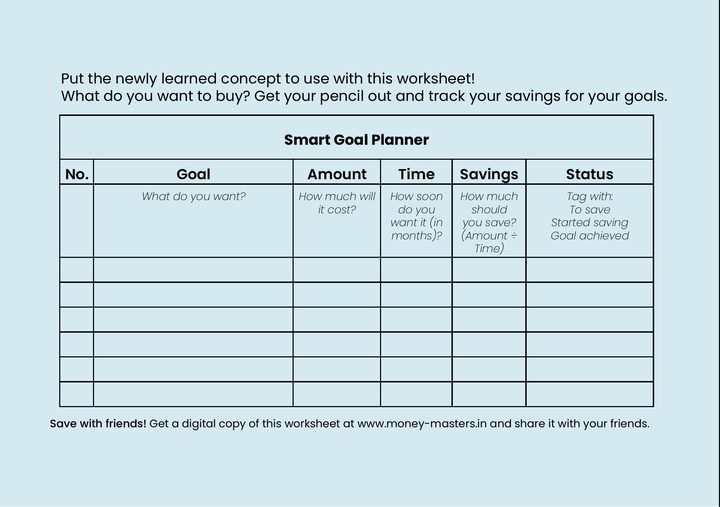
  • Smart Goal Planner worksheet

    From “Dev Learns to Save”

    Smart Goal Planner

    What do you want to buy? Plan the amount, the time and how much to save each month.

    Download PDF
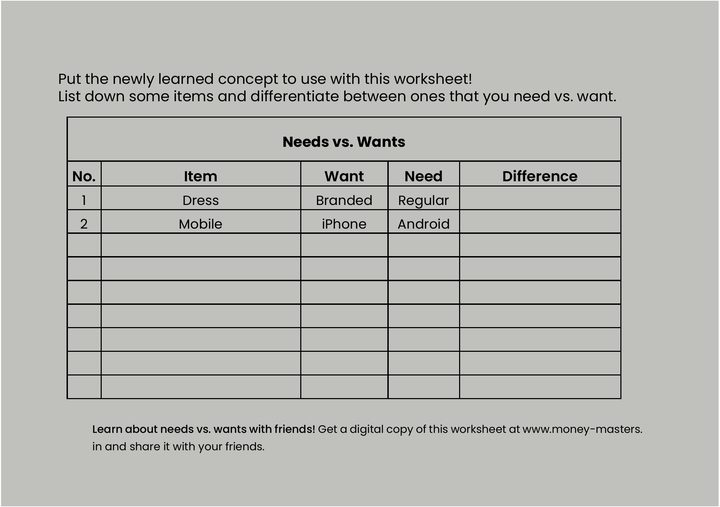
  • Needs vs. Wants worksheet

    From “Akash Goes Shopping”

    Needs vs. Wants

    List everyday items and sort out what you need from what you want.

    Download PDF
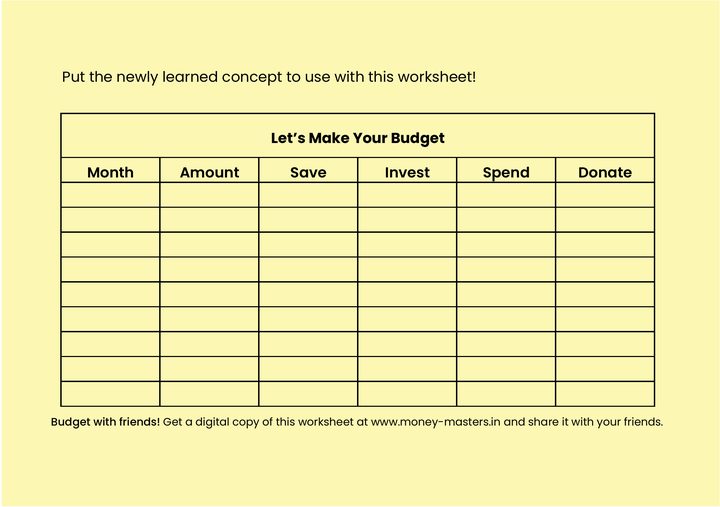
  • Let’s Make Your Budget worksheet

    From “Month End”

    Let’s Make Your Budget

    Split each month’s money into save, invest, spend and donate.

    Download PDF

Why did we all learn about money so late in life? Our children deserve a head start.

Schools still don't teach money. This book can help.

What parents say

Loved by families.

“We all grew up hearing about various stories that stayed in our minds for lifetime & guide our behavior. Similarly, the stories in this book will help young minds in their everyday actions as they grow as financially aware adults.”
Anil|Verified purchase · Amazon.in
“Educating next generation about money at young age is extremely important and the book does it beautifully in an easy to understand manner.”

Jigar Patel

Verified purchase · Amazon.in

“Some topics like diversification and passive income are topic you don't generally see in kids money book, that's a big plus.”

Rajit Desai

Verified purchase · Amazon.in

“Excellent book for teaching all key concepts via stories. Quite engaging as bedtime stories for us and little children.”

Amit Jha

Amazon.in

“Those parents like me must have felt the need to educate children about money… this book explains concept of money in a very easy and lucid manner.”

Hitendrakummar

Verified purchase · Amazon.in

“The stories are appropriately designed. The quality of the paper and the pictures shown are very good. Highly recommended!!!”

Preeti

Verified purchase · Amazon.in

“I gifted this book to my niece and she loved it. Valuable lessons are provided in forms of short stories…”

Quality Shopper

Verified purchase · Amazon.in

“Creative, colorful, and educational – perfect for teaching kids the value of money in a simple way.”

Abhishek

Verified purchase · Amazon.in

“About time bedtime stories switched from fairytales to money talk.”

Sushobhan Chowdhury

Reader

“Definitely a recommended book for parents to give to their children.”

Manoj Acharya

Reader

Read all reviews on Amazon →

Forewords

In their words.

Kunjal and Janhvi have broken down the complexities of money management to very simple stories which can be understood by any age group of children… I would consider this book an essential read for every child.

Anwar Tamboowala

Associate Director – IBM Asia Pacific and Japan

Foreword to the 1st edition

I would even go as far as saying that Kunjal’s book should be included in our primary school curriculum… I would urge all parents to pick up this well-written book, and start their children on their path to financial literacy.

Balaji Reddipalli

Head – Supply Chain (Consumer Products), Borosil Limited

Foreword to the 2nd edition

The story of this book

How it all began.

An aunt, a niece and an internship project in 2018.

In 2018, Janu, as Janhvi is fondly called, wanted to do something meaningful during her Mass Communications internship. Looking at her exceptional story-writing abilities, Kunjal, her aunt who conducted Kids & Money workshops, came up with a brilliant idea. Why not write money stories for young children?

That’s how this project started: Kunjal would explain the money concepts to Janu, who would craft beautiful stories and create delightful illustrations to accompany each tale.

The book was soon ready as a light and quick read, perfect for young minds. However, due to its compact size, publishers felt that this was a booklet, not a book. Undeterred, we decided to take matters into our own hands and self-published the book.

Through our Amazon listing, we were able to get the book in the hands of hundreds of children all over India. Many parents bought this as a ‘return gift’ for their children’s birthdays. And we sold out the first edition. Yay!

Our dream is that these stories help lakhs of children to start their money journey. And so, our focus is on getting this book out at the lowest possible cost so that parents can raise financially savvy children from a young age.

Read it already? We would be so grateful if you could leave a review on Amazon. It really (no, really) means a lot.

The people behind the book

Meet the authors.

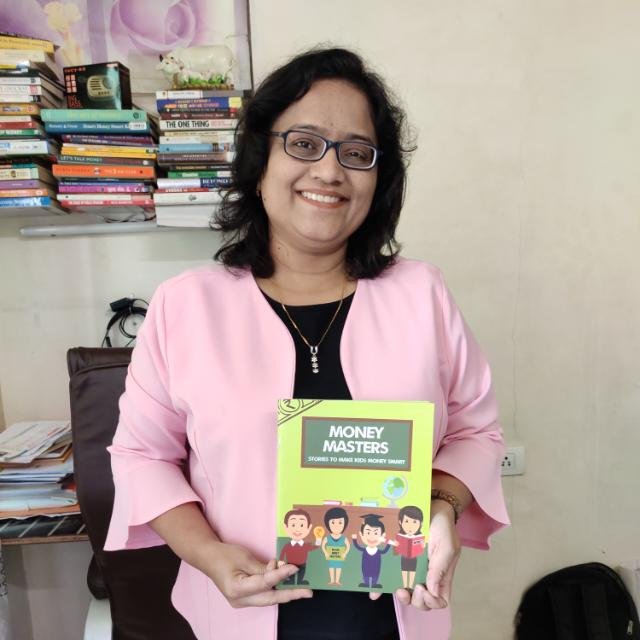
Portrait of Kunjal Shah

Ideas & Concept

Kunjal Shah

Kunjal Shah is a law graduate with an extensive understanding of personal finance. She helps families and youngsters learn money matters, and has been trained by international faculty in public speaking.

Corporates in India and abroad have engaged her for financial wellness programmes for employees, adults, youngsters and children. She has created her own programme that uses gamification to help children learn money concepts early.

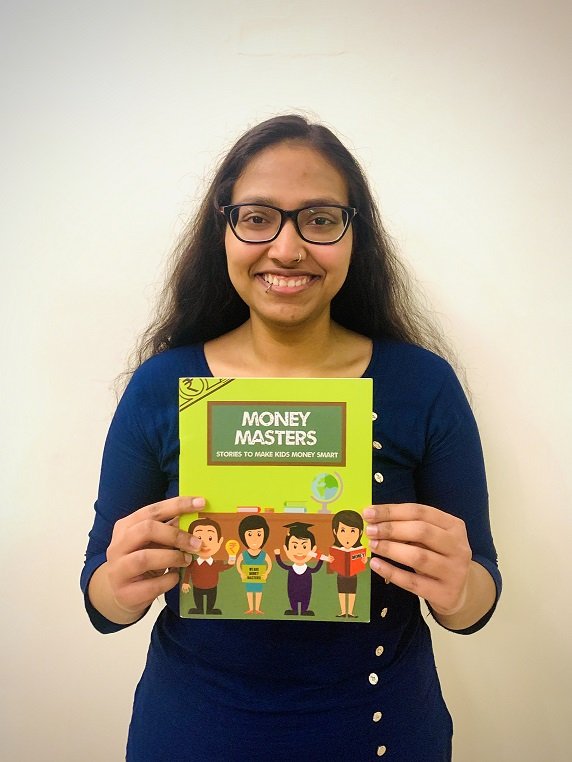
Portrait of Janhvi Langde

Author & Illustrator

Janhvi Langde

Janhvi Langde studied BMM at St. Xavier’s College, Mumbai, after commerce at R. A. Podar College. Learning those subjects, she realised how important financial concepts are, and how shrouded in mystery they are for most people.

An avid reader since childhood, she knew that stories read at a young age leave a lasting impact. With this book she hopes to simplify finance and help raise a financially literate generation.

Now in its 4th print

Give your child a head start with money.

A thoughtful gift for birthdays, return gifts and school libraries.